Ponder/Reviews/Church Plant Admin Workflow Review
Illustrative ministry scenario

Church plant admin workflow review.

This illustrative ministry scenario follows a church plant administrator or planter's spouse coordinating midweek discipleship resources after Sunday. It is not a named-church testimonial. It evaluates a lean, pull-based sermon-to-week workflow.

Verdict: Ponder fits church plants that need parents and lay leaders to pull reviewed sermon-based drafts without hiring a full discipleship staff or adopting pastor-push distribution tools.

Strengths

  • Starts from one Sunday sermon instead of five disconnected curricula.
  • Lets Group Leader and Parent drafts serve different rooms.
  • Keeps the planter free from writing every midweek packet.
  • Refuses clips, slides, social posts, and congregation drip as core features.

Watch-outs

  • Someone still needs to teach leaders how to review drafts.
  • Sermon rights and captions still matter for intake.
  • A plant can over-automate if it skips human review.
  • This scenario is illustrative, not a quote from a named church.

Scenario setup

Imagine a church plant with one preacher, a handful of volunteers, and no discipleship department. Sunday landed well. Midweek needs a group guide and a couple of family prompts. The admin or planter's spouse does not want five tools. They want one sermon to become reviewed drafts for the people who asked for help. This is an illustrative ministry scenario, not a case study naming a real plant.

A lean Sunday-to-midweek workflow

After service, the plant stores a manuscript or captions-on recording it has the right to use. Group leaders generate Group Leader drafts. Parents who want help generate Parent drafts. If kids or youth ministry exists, those leaders use Children's Educator or Youth Educator. The admin's job is coordination and reminder, not content broadcasting. Ponder stays pull-based. No automated congregation drip.

Buyer role versus output role

The planter may buy Church seats so volunteers can work under one plan. That makes the pastor a buyer. When the planter uses Ponder personally, Individual or Parent remains correct. There is no pastor output for writing sermons, slides, or social posts. That boundary keeps the plant out of competitor lanes and keeps preaching with the preacher.

Scenario recommendation

In this scenario, Ponder is recommended for plants that value sermon continuity, lay equipping, and review discipline. It will frustrate teams looking for clip factories or mass devotion blasts. For lean churches that want people to carry Sunday into Wednesday with care, the fit is strong.


Questions this review answers

Can a church plant use Ponder without a full staff?

Yes. Parents and lay leaders can pull reviewed drafts from one sermon so the plant does not need a large content team.

Does this workflow push content to the whole church?

No. Ponder is pull-based. People generate and review drafts for the contexts they serve.

Is this a real named church plant review?

No. It is an illustrative ministry scenario for evaluating the workflow.

Actual Ponder app screenshots

Try the workflow this review describes.

Bring one sermon, choose one audience, and keep human review at the center before you use the draft.

Ponder actual onboarding screen showing persona choices for parents, group leaders, kids ministry, youth ministry, individuals, and pastors.
Choose the setting

Actual onboarding screen where a user starts by naming the discipleship setting.

Ponder actual help center screen showing searchable support categories for parents, group leaders, kids ministry, pastors, and theology.
Find practical help

Actual help center screen with searchable support before and after a first sermon.

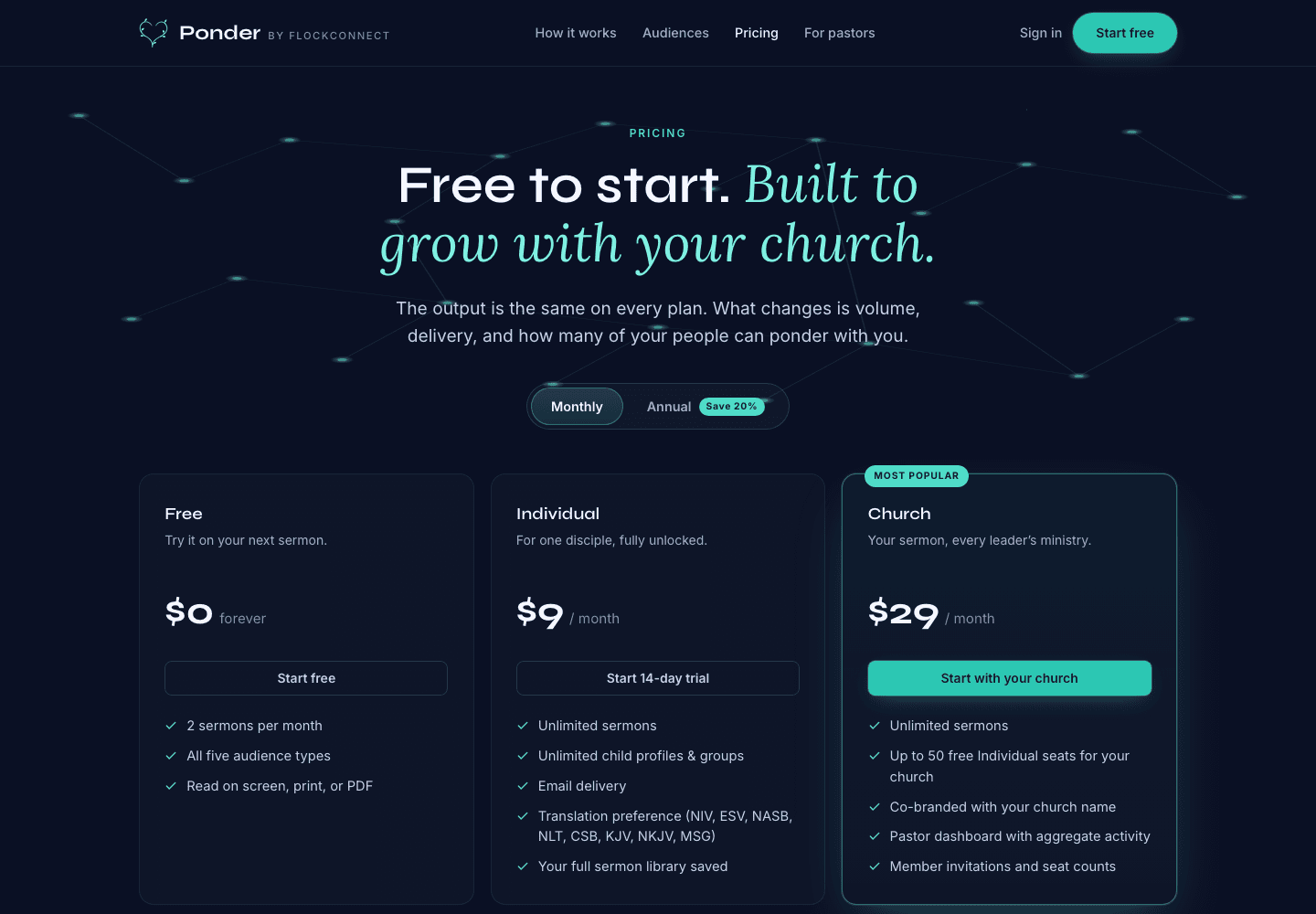
Ponder actual pricing screen showing Free, Individual, and Church plans.
Pick the right plan

Actual pricing screen showing the free start, individual plan, and church plan.

Church Plant Admin Workflow Review · Ponder